OEM vs Aftermarket Powersports Parts: Pros, Cons & What to Choose

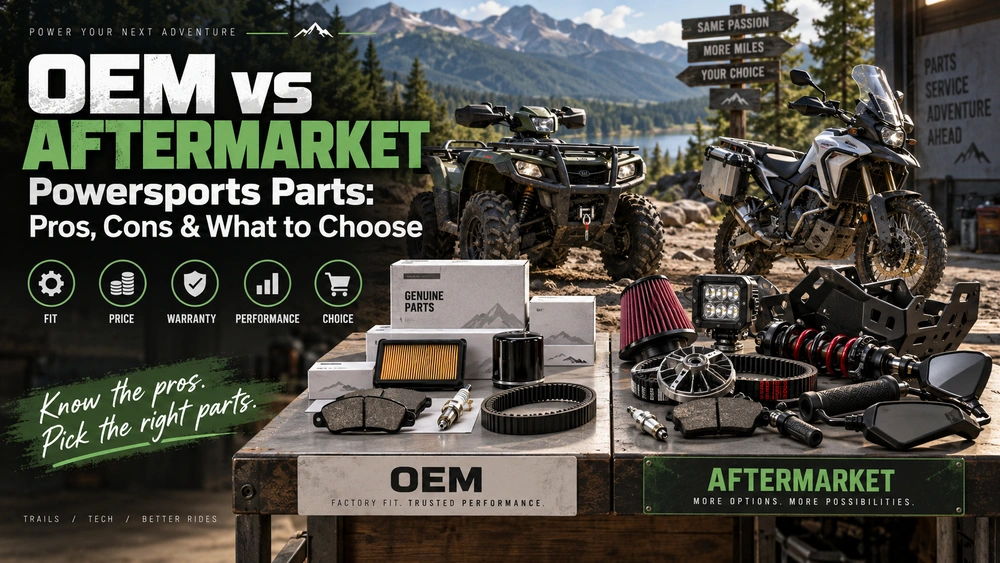
Choosing OEM vs aftermarket powersports parts is not as simple as saying one category is always better. OEM parts generally prioritize factory fitment and original vehicle specifications, while aftermarket products can offer different pricing, materials, designs, features, or performance characteristics.
At Backcountry Motorsports Ltd in Pemberton, we recommend making the decision part by part. Fitment, vehicle system, riding conditions, warranty considerations, installation quality, and what you expect the component to do all matter.
Should You Choose OEM or Aftermarket Parts?
|
If Your Priority Is |
Start With |
|
Factory-style fit and specifications |
OEM |
|
Model-specific maintenance or repair |
OEM |
|
Warranty-sensitive repair |
Confirm OEM requirements first |
|
Customization or specialized functionality |
Compare quality aftermarket options |
|
Different materials, styling, or performance |
Aftermarket may offer more choices |
|
An older or harder-to-source machine |
Compare both |
|
Critical engine, brake, steering, or electronic component |
Take a more conservative, vehicle-specific approach |
OEM is usually the strongest starting point when exact fitment, factory specifications, and system compatibility matter most. Quality aftermarket parts can make sense when you need a different feature, price point, material, or specialized setup.
The important word is quality. “Aftermarket” describes who supplies the product, not whether the product is automatically good or bad.
What Is the Difference Between OEM and Aftermarket Parts?
OEM parts are parts supplied through or for the original vehicle manufacturer and designed for specific vehicle applications.
Aftermarket parts come from third-party manufacturers and are designed as replacements, alternatives, or upgrades.
|
Factor |
OEM Parts |
Aftermarket Parts |
|
Fitment |
Designed around specified vehicle applications |
Depends on manufacturer and application |
|
Specifications |
Usually follows factory requirements |
Can match or intentionally differ from factory design |
|
Selection |
More factory-focused |
Often broader |
|
Price |
May cost more |
Can cost less, the same, or more |
|
Installation |
Often straightforward when correctly matched |
May require more compatibility checks |
|
Warranty |
Manufacturer-backed parts coverage may apply |
Depends on product manufacturer |
|
Customization |
Usually factory-oriented |
Often more choices for specialized use |
Neither category wins every comparison.
What Are the Benefits of OEM Powersports Parts?
One of the biggest benefits of OEM parts is predictability.
When we source an OEM component for a particular machine, we can identify the application using the vehicle's year, model, trim, and other identifying information instead of relying on a generic fitment claim.
That matters for components such as:
-
Oil and air filters
-
Drive belts
-
Brake components
-
Bearings and bushings
-
Electrical components
-
Sensors
-
Engine parts
-
Drivetrain components
-
Steering and suspension parts
-
Model-specific body components
Polaris® provides an extensive OEM parts catalogue covering maintenance, braking, electrical, engine, steering, suspension, driveline, and other systems.
Polaris® also currently provides limited warranty coverage on many parts and accessories. Coverage length and conditions vary by product category, so check the terms for the specific component.
At Backcountry Motorsports, our Parts and Accessories department specializes in genuine OEM products and can help locate and order specific parts when they are not already available.
When Do Aftermarket Powersports Parts Make Sense?
Aftermarket powersports parts can make sense when you want something different from the original configuration.
Common examples include:
-
Specialized lighting
-
Storage systems
-
Protection equipment
-
Wheels and tires
-
Suspension upgrades
-
Handlebars and controls
-
Utility equipment
-
Performance-oriented components
Aftermarket does not automatically mean lower quality.
Established manufacturers may design components around very specific riding, work, weather, or performance needs that are different from the factory setup.
The important questions are:
-
Does it fit your exact vehicle?
-
Who manufactures it?
-
What warranty does the manufacturer provide?
-
Does installation affect another vehicle system?
-
Is the product appropriate for how you use the machine?
Manufacturer-Sold Does Not Always Mean OEM
This is an important distinction.
A product sold through a vehicle manufacturer's accessory ecosystem is not necessarily an OEM replacement part.
For example, Polaris® currently offers products from aftermarket partners including Kolpin, Pro Armor, Rhino-Rack®, RIGID®, JBL® and Rockford Fosgate® alongside Polaris Engineered Parts & Accessories.
That gives owners more choices, but it also shows why it is better to evaluate the specific product and application rather than assuming everything must fit neatly into either “factory” or “aftermarket.”
What Are the Downsides of OEM Parts?
OEM is not automatically the best choice for every job.
Possible disadvantages include:
Price: Some OEM parts can cost more than alternatives.
Selection: The factory catalogue may offer fewer choices when you want a different design, material, appearance, or function.
Availability: Components for older or less-common machines may need to be ordered or may eventually become harder to source.
For an older ATV, side-by-side, motorcycle, or snowmobile, a reputable aftermarket replacement can sometimes be a practical solution.
The key is verifying fitment and quality before installation.
What Are the Risks of Aftermarket Parts?
The biggest concern is not simply that a component is aftermarket. It is whether the part is suitable for the machine and installed correctly.
Potential problems include:
-
Incorrect fitment
-
Poor materials or manufacturing quality
-
Improper wiring
-
Wrong fluid or lubricant specifications
-
Oversized tires affecting handling or clearance
-
Suspension changes affecting vehicle geometry
-
Performance modifications affecting other systems
-
Poor instructions or limited warranty support
Polaris® explains in its current aftermarket-component warranty guidance that aftermarket modifications or unapproved parts can contribute to trouble codes, drivability issues, durability problems, or failures.
Polaris® also states that when an aftermarket or unapproved component can be associated with the need for a repair, that repair may not be covered under the applicable warranty.
That does not mean installing one aftermarket accessory automatically cancels every aspect of the vehicle's warranty.
Check the warranty terms and the exact modification before making changes.
Which Parts Deserve the Most Conservative Approach?
We take a more conservative approach when a component directly affects a critical vehicle system.
Examples include:
-
Engine components
-
Drivetrain parts
-
Braking components
-
Steering components
-
Cooling-system components
-
Vehicle electronics
-
Sensors
-
Lubricants and specified fluids
A decorative accessory is a different decision from a brake component or engine sensor.
Before ordering a replacement or upgrade, ask:
-
Is this routine maintenance, a repair, or an upgrade?
-
Is the exact year, model, and trim listed?
-
Does the part interact with another accessory?
-
Are calibration or special tools required?
-
Could installation affect warranty coverage?
-
Is professional installation recommended?
-
Who supports the product if something goes wrong?
Those questions are more useful than assuming all OEM parts are good and all aftermarket parts are bad.
Why Does Fitment Matter Around Pemberton?
Powersports machines around Pemberton and the Sea-to-Sky can see dust, mud, rough access conditions, cold weather, mountain use, utility work, and significant seasonal changes.
A part that is only “close enough” becomes a bigger concern when the machine is being used far from pavement or under heavier operating conditions.
Backcountry Motorsports currently supports several powersports categories, including Polaris® ATVs, Polaris® side-by-sides, Beta and TM motorcycles, and Polaris® snowmobiles.
Each type of machine has different fitment, maintenance, and operating requirements.
That is why we recommend providing the model, model year, trim, and vehicle information when requesting a part.
Does Professional Installation Matter?
It can matter as much as the component itself.
A quality part can still create problems when installed incorrectly.
Our Backcountry Motorsports Service Department handles ATV, side-by-side, motorcycle, and snowmobile maintenance and repair with certified powersports technicians and genuine parts.
Professional installation is especially worth considering for:
-
Electrical equipment
-
Braking components
-
Drivetrain parts
-
Suspension changes
-
Steering components
-
Accessories interacting with multiple systems
If you are evaluating modifications on a pre-owned machine, our guide to new vs. used Polaris® ATVs and UTVs also explains why installation quality and previous modifications should be part of a used-vehicle inspection.
Get Powersports Parts in Pemberton
Not sure whether OEM or aftermarket makes more sense for your machine?
Contact our Parts and Accessories team with:
-
Vehicle type
-
Make
-
Model
-
Model year
-
Trim when applicable
-
The part you need
-
Whether you are replacing, repairing, or upgrading something
-
How the machine is normally used
We can help identify compatible OEM powersports parts, locate or order specific components, and coordinate professional installation through our Service Department when needed.
OEM vs Aftermarket Parts FAQs
Are OEM powersports parts always better than aftermarket parts?
No. OEM parts are a strong choice when factory-style fitment and specifications are priorities. A reputable aftermarket component can make more sense when you want a different feature, material, price point, or specialized application.
Can aftermarket parts affect a Polaris® warranty?
Yes, in some situations. Polaris® states that damage or repairs associated with aftermarket or unapproved parts, accessories, lubricants, or modifications may not be covered. An aftermarket component does not automatically eliminate all warranty coverage.
Are OEM replacement parts worth paying more for?
They can be when exact fitment, factory specifications, manufacturer parts coverage, or system compatibility matter. Compare the specific OEM and aftermarket options rather than assuming the more expensive product is automatically better.
How do I know whether an aftermarket part fits my ATV or UTV?
Verify the exact year, make, model, trim, mounting requirements, and any interacting accessories. Do not assume a product fits because it is advertised broadly for one vehicle family.
Can Backcountry Motorsports Ltd order parts that are not in stock?
Yes. Our Parts and Accessories department states that the team can help locate specific or uncommon components and place orders when required.