
ATV Maintenance Checklist & Seasonal Service Tips

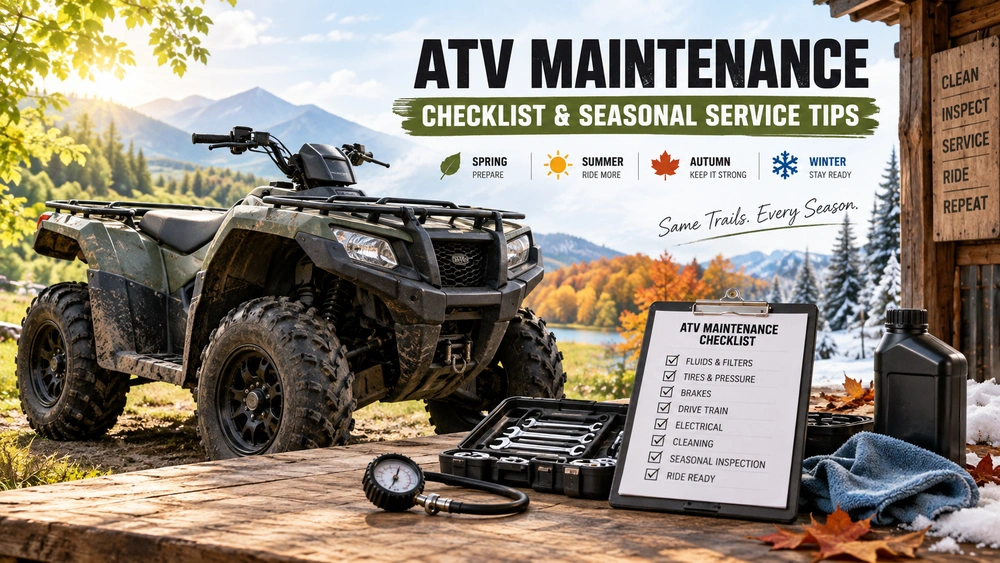
A useful ATV maintenance checklist covers more than oil changes. Tires, brakes, air filtration, fluids, drive components, suspension, battery condition, and seasonal storage all affect whether your ATV is ready when you need it.
At Backcountry Motorsports Ltd in Pemberton, we service ATVs used in conditions that can include dust, mud, water, cold starts, property work, and long backcountry days. Those conditions can change how closely an ATV needs to be inspected and maintained.
Quick ATV Maintenance Checklist
|
When |
What to Check |
|
Before each ride |
Tires, brakes, fluids, steering, suspension, lights, leaks and visible damage |
|
After dusty or muddy riding |
Air filter, cooling areas, brakes, belt/drive concerns and accumulated debris |
|
After significant water exposure |
Fluids, filtration, brakes and possible contamination |
|
Start of riding season |
Battery, tires, brakes, fluids, filters, steering, suspension and scheduled service |
|
Before long-term storage |
Cleaning, battery care, fluids, tires and manufacturer storage procedure |
|
At scheduled intervals |
Follow the exact owner's manual for oil, filters, belt, fluids and other service |
If something feels loose, damaged, unusual, or unsafe, deal with it before heading farther into the backcountry.
For additional manufacturer guidance, review the official Polaris® Sportsman® maintenance resources.
Follow the Maintenance Schedule for Your Exact ATV
There is no universal ATV maintenance schedule that applies to every machine.
Intervals can depend on:
-
Model and engine
-
Operating hours
-
Kilometres
-
Vehicle age
-
Riding conditions
-
Load and work use
-
Severe-use conditions
Polaris® owner guidance instructs riders to follow the maintenance schedule for the exact vehicle.
For example, the current 2026 Sportsman® 570 owner's manual states that vehicles subjected to severe use should be serviced at 50% of the normal stated interval.
That is a Sportsman® 570 example, not a universal interval for every ATV.
Our current inventory includes both the 2026 Polaris® Sportsman® 450 H.O. and 2026 Polaris® Sportsman® 570, which is another reason we recommend using the manual for the exact machine rather than borrowing another model's maintenance schedule.
What Counts as Severe ATV Use?
Polaris® defines severe use to include conditions such as:
-
Frequent mud, water, or sand exposure
-
Prolonged dusty operation
-
Short-trip cold-weather use
-
Prolonged low-speed operation under heavy load
-
Extended idling
-
High-RPM or racing-style use
Those conditions are relevant around Pemberton because local riding and work use can involve dust, wet or muddy terrain, changing weather, cold shoulder-season starts, and slower backcountry travel.
If your ATV regularly sees those conditions, do not assume the standard calendar interval tells the whole story.
Spring ATV Maintenance: Start With a Baseline
If your ATV has been stored through winter, check it before the first long ride.
Start with:
-
Battery condition and terminals
-
Tire pressure and condition
-
Brake operation
-
Engine oil and required fluids
-
Air-filter condition
-
Visible leaks
-
Drive belt or drive system according to the manual
-
Steering and suspension
-
Lights and controls
-
Maintenance that became due during storage
Also inspect for damaged wiring or signs of rodents if the machine sat for an extended period.
If you want us to establish a pre-season baseline, our Backcountry Motorsports service department handles ATV oil changes, regular maintenance, and repairs.
Summer ATV Maintenance: Pay Attention to Dust, Mud, and Heat
During the active riding season, filtration and cooling deserve extra attention.
Dust can load an air filter more quickly, while mud can accumulate around brakes, suspension, and cooling areas.
After a dirty ride:
-
Clean heavy mud and debris from the ATV
-
Inspect the air filter
-
Check radiator and cooling areas
-
Look at brakes and tires
-
Inspect suspension and steering components
-
Watch for belt or clutch symptoms
-
Look for leaks or damaged hoses
If the ATV was exposed to unusually deep water and you suspect contamination entered a mechanical system, stop using the machine and have it inspected rather than continuing to ride.
For replacement filters, fluids, belts, and other maintenance components, contact our parts and accessories department, which supplies genuine OEM parts and can help identify components for your machine.
Fall and Winter Storage: Prepare Before You Park It
Good ATV seasonal maintenance makes the next riding season easier.
Before long-term storage:
-
Clean the ATV thoroughly.
-
Complete maintenance that is already due.
-
Follow the manufacturer's battery-care procedure.
-
Check fluids and coolant requirements.
-
Inspect tires and brakes.
-
Address leaks, worn belts, weak batteries, or other known problems.
-
Follow the storage instructions in the owner's manual.
Do not leave an obvious repair until spring and expect it to improve while the ATV sits.
What Should New Polaris® ATV Owners Know?
If you are buying or recently purchased a Sportsman®, maintenance planning should begin with the vehicle's exact owner documentation.
Our current new ATV inventory includes Polaris® Sportsman® models for different types of work and recreation.
You can also explore our Polaris® off-road vehicle lineup or read our guide to why the Polaris® Sportsman® 450 H.O. fits Pemberton riding and work.
The important point after purchase is simple: use the service schedule for the ATV you actually own.
Do Not Forget BC ORV Registration Before Riding on Crown Land
Mechanical readiness is only part of the first-ride checklist.
The Province of British Columbia's ORV registration guidance states that ATVs used on Crown land must be registered unless an exemption applies.
When operating a registered ORV on Crown land, riders must also:
-
Clearly display the applicable ICBC plate or sticker
-
Carry proof of registration
Registration does not mean every road, trail, or riding area is open to ATVs. Check current access and operating requirements for the specific area before leaving.
Schedule ATV Service in Pemberton
If your ATV is coming out of storage, has been through a hard riding season, or is approaching scheduled maintenance, schedule service with Backcountry Motorsports Ltd.
We can help with:
-
Oil changes
-
Routine maintenance
-
Seasonal inspections
-
Repairs
-
OEM parts and maintenance items
Our shop is located at 1935 Carpenter Rd in Pemberton, BC, so local riders can handle maintenance and parts support without leaving the valley.
ATV Maintenance FAQs
How often should I change the oil in my ATV?
Follow the owner's manual for your exact ATV. Oil-change intervals vary by model, hours, kilometres, and use. Severe operating conditions can require more frequent service.
Does riding in mud mean my ATV needs service sooner?
It can. Polaris® classifies frequent mud and water exposure as severe use. After muddy riding, inspect filtration, brakes, drive components, lubrication points, cooling areas, and signs of contamination more closely.
How often should I inspect an ATV air filter?
Follow the interval in your owner's manual, but check it more often during prolonged dusty use. Riding conditions can load a filter faster than a calendar interval suggests.
What should I check after storing an ATV all winter?
Check the battery, tires, brakes, fluids, air filter, drive system, suspension, steering, visible leaks, wiring, and any maintenance that became due during storage.
Does an ATV need registration for Crown land in BC?
Generally, yes, subject to applicable exemptions. British Columbia requires prescribed ORVs used on Crown land to be registered and display the appropriate ICBC plate or sticker, with proof of registration carried by the operator.